“I am the true vine, and my Father is the vinedresser. Every branch in me that does not bear fruit he takes away, and every branch that does bear fruit he prunes, that it may bear more fruit. Already you are clean because of the word that I have spoken to you. Abide in me, and I in you. As the branch cannot bear fruit by itself, unless it abides in the vine, neither can you, unless you abide in me. I am the vine; you are the branches. Whoever abides in me and I in him, he it is that bears much fruit, for apart from me you can do nothing. If anyone does not abide in me he is thrown away like a branch and withers; and the branches are gathered, thrown into the fire, and burned. If you abide in me, and my words abide in you, ask whatever you wish, and it will be done for you. By this my Father is glorified, that you bear much fruit and so prove to be my disciples. As the Father has loved me, so have I loved you. Abide in my love. If you keep my commandments, you will abide in my love, just as I have kept my Father’s commandments and abide in his love. These things I have spoken to you, that my joy may be in you, and that your joy may be full.”
John 15:1-11 ESV
“And he told them many things in parables, saying: “A sower went out to sow. And as he sowed, some seeds fell along the path, and the birds came and devoured them. Other seeds fell on rocky ground, where they did not have much soil, and immediately they sprang up, since they had no depth of soil, but when the sun rose they were scorched. And since they had no root, they withered away. Other seeds fell among thorns, and the thorns grew up and choked them. Other seeds fell on good soil and produced grain, some a hundredfold, some sixty, some thirty. He who has ears, let him hear.”
Matthew 13:3-9 ESV
Reading these two verses, with no context, we could assume Jesus just loves gardening or he is preparing his disciples for the next Chelsea garden show but, let’s be honest, we all know these verses are pointing to something deeper. It would be far easier if these verse were just about our gardens. Yet, we recognise this imagery of pruning and preparation of soil indicates something we need to do in our lives, perhaps a change or a challenge from God himself through the words of Jesus. It can be easy to miss the depth of these verses, we sense they are trying to give some advice and sure I’m happy to ‘abide’ and ‘prune’ (whatever that means!). We read on, hoping that we won’t have to look too deeply at our own lives, knowing that the commands to allow pruning and abiding may actually point to a deep transformation that some of us just aren’t ready to enter into (myself, many a times included!)
These verses leaves us shifting in our seats, recognising a self evaluation is required. We quickly analyse and find a way to confirm to our selves “Yes, I love Jesus and I am abiding in him… sure! And of course I am the good soil…”
The issue is, these verses should bring us the question, to look inward in an honest way, to check the condition of our souls and the habits of our lives. If you’re wondering how I came to that conclusion, and still think Jesus is just giving good gardening advice, bear with me.
Alternatively, perhaps, you are honestly evaluating right now and thinking… I’m not sure I’ve ever understood the abiding in Christ and I fear the seeds have fallen on thorns or rocky ground. What do I do? Yet, it often feels the verses deliver no practical instruction so we move on.
I’m hoping to unpick some of what God has spoken to me through these verses and hopefully offer some guidance on how to apply these to our lives. I know I will miss much of the depth, and the beauty with all the words of Jesus is they are like an endless well, more can be drawn from them over decades of study. I’m writing what I know now, and I am sure in a decade I will draw even more depth and wisdom from these verses. This is the glorious mystery of the word, it is a living word that should stir us, and bend us and leave us transformed.
Jesus’ words are reflecting on the fact that God is wildly interested in the conditions of our souls.
I don’t believe that these verse are regarding our salvation. John has already made it clear before he shared the words of Jesus regarding abiding that “For God so loved the world, that he gave his only Son, that whoever believes in him should not perish but have eternal life. For God did not send his Son into the world to condemn the world, but in order that the world might be saved through him.” John 3:16-17
We know that our belief in Jesus as the risen son of God is enough, nothing we can ever do or be will change our inheritance as children of God. “In him you also, when you heard the word of truth, the gospel of your salvation, and believed in him, were sealed with the promised Holy Spirit” Ephesians 1:13
Yet, Jesus’ teaching and way of life reveals to us so much more than just a set of beliefs. Becoming a Christian is not just that we assign our selves to some confessions, like joining a secret club as a child, becoming a Christian allows for the miraculous transformation for us to become more like Christ.
Revelations sets out an impressive invitation that “To him who loves us and has freed us from our sins by his blood 6 and made us a kingdom, priests to his God and Father, to him be glory and dominion forever and ever. Amen.” Rev 1:5-6. There will be a time when we, sons and daughters of the king, will be invited into dominion with Jesus. God wants us to be active participants in his future kingdom. As a result, our time here in our earth is not what we can do for ourselves now, but how we can be transformed into Christ like priests, with our own unique gifting and personhood.
This has personally been an exciting and jaw-dropping revelation that there is a commission upon my life, both for now and beyond, that I am to become something more than I could ever have wished for or imagined. And here, in these simple parables Jesus is showing us the importance of caring for our souls and the way we live now matters. Not because we might be kicked out the kingdom but because he sees who we can become and wants to invite us into that glorious picture. I recognise this and see that I would much rather have my identity and soul formed by the creator of the heavens and earth than by my own accord and hands. He is after all, the great gardener.
An invitation to abide in Jesus
Now we recognise that God is interested in the conditions of our souls, we can see Jesus offering an invitation to us to be people that bear fruit by the seemingly simple act of abiding in him.
It has become increasingly apparent to me over the last few months that the most important aspect of living as a Christian is to know that I am beloved and to abide fully in Jesus.
I am a beloved child of God. As I read over John 15:1-11 I see this warming and lavish invitation to rest in the love of the Father. I can almost hear the whispers of God’s voice calling my name to come to him. Come to Jesus. Come to me he says. Did you know, your name is on the lips of Jesus? As he died on the cross, your name was written on his heart. As God was creating the cosmos, he included you, with every hair on your head and every laugh you make, he knew how he wanted you to be.
As I read this, I hear a jealous God too. How can I describe my God as jealous? He is jealous for me. He is jealous for me to know his love, to live in the way that he knows best for me. To see me realigned with my creator, to no longer fight against the flow of who I am but to turn and rest into him. His power is made strong in our weakness. He desires and longs to be our Father. I am only just beginning to grasp the very tip of this iceberg, and it has already been enough to shift my soul from a thirsting, anxious state to a soul that finds rest.
“As the branch cannot bear fruit by itself, unless it abides in the vine, neither can you, unless you abide in me.”
One of the resistances I felt to this revelation was that perhaps becoming a Christian that pleases God is all about following the rules book of commands, to become like the stereotypical Christian who has “What would Jesus do” stickers on their cars, never swears and never drinks. I will get on to the practical outpouring of these passages in time and how there may be pruning in our lives. But this is a shallow reading of this and misses the depth and gravitas of the invitation here. We cannot bear fruit alone and what is the fruit anyway?
Is the fruit to live in a nice neighbourhood with a white picket fence, to make apple crumbles, be on the PTA and produce nice polite children who can recite bible verse on command?
No, our calling to become Christlike does not erase our individuality, but it does bring us under the shelter and governance of a God who loves us and wants to do the heavy lifting. Come to the Father, abide in him and our fruits will flow from this. I do believe the fruits reflect the fruits of the spirit, that whatever we do, whoever we are, we become a people of kindness, patience, loves, joy, self-control, gentleness, peace and goodness. We want to become people of the prescence of God,
Have you met people like this? I can think of a few people in my life who when they come to mind, I can recall the feeling of peace I felt when around them. Because they bore a fruit that was almost tangible. When I asked them about what they do, I realised they are a people who understand how to abide in Jesus. They make space in their life to allow their souls to return to the hands of their creator, through silence and prayer. They simply meditate on the love of Jesus.
These people look different, one a 70 year old lady who volunteers for the Samaritans and does make apple crumbles for her adorable grandchildren. Another, a 37 year old builder who loves his kids, has long hair and says “far out” a lot. They have retained their individuality, the beautiful uniqueness of who they are, but brought it under alignment with their maker to become people who abide. They bear good fruit.
Unfortunately, we can probably think of people, even maybe our selves, who have not understood the call to abide. They live anxiously, running to the next high, the next pay check, perhaps they are looking out for no.1 (their selves), they lack generosity, they gossip and don’t exude a gentleness. When in the presence of these people, worse even when this becomes us, the atmosphere is strained, the fruits are feeble or non existent. They may profess the name of Jesus, they may have their salvation sealed but they are missing the banquet already laid out for them.
The condition of our soul is the condition of the soil
John Ortberg in his book ‘Soul Keeping’ does a fantastic chapter on this. He helps us untangle the mystery in this parable. I will briefly summarise.
There are four soul types
- The hardened soul- This seed fell on the path. If our soul is hardened the seeds cannot take root. Perhaps our soul is damaged, we’ve been hurt and beaten by circumstances and people. We grow bitter, we see ourselves as victims and this is an integral part of our identity. This is a tricky condition because the victim does not want to hear how they could be hurting themselves by not softening their soul to the grace and love of Christ. They feel entitled to their hurt. They are also fearful, that to loosen grip and allow love in, they could be hurt. Safer to be hardened I guess.
- The shallow soul- This seed falls on rocky soil. This is superficiality, only perpetuated by our culture and society. I feel many of us are in this category more than we would like to admit. We live shallowly, we simply don’t even allow our minds to consider the depth of our souls. We don’t engage in meditation of the wild love of God, of anything really, outside of our own immediate lives and ourselves. Without sounding like a broken record and I know this critique of our generation is given a lot, but I stand by my concern that social media is the epitome of this. It perpetuates shallowness. Much of social media is about how we look and what we have. It does not allow us to go into the depths. This does not mean all content creators are shallow, but the ‘instant gratification’ and flashiness of much of social media does not allow us to ponder on the deeper stuff of life. When crisis hits, we have not put down deep roots to withstand turbulence. Our souls are easily shaken. “Deep calls to deep… In the roar of your waterfalls” Psalm 42:7
- The cluttered soul – This seed falls among thorns. This is where things in our lives come up and choke our souls. Perhaps you’ve had the rush of the first love with Jesus, the honeymoon phase if you like. But in the business of your own life, in meeting your own desire, you have cluttered your life with emails, buying more, earning more, seeing more. You love to plan, you fill your life with enough stuff and events and even good things such as people, that we no longer have a quiet place to hear our souls cry to know its maker. In the most tragic cases, there is no use for God, for we already have many Gods, in our money, our marriage, our friends, our work and our stuff. “If the devil can’t make you sin, he will make you busy” (Corrie ten Boom).
- The abiding soul (not mentioned in Ortberg’s book, but I have attempted to explain)- This seeds falls into the good soil, the arms of Christ. I believe this is where we truly learn our resting place. We take our foot off the gas, put our phone down, take a deep breath to soften our fear and open up. We turn to look at the face of Jesus and our soul abides in the knowledge that I am enough, I am beloved, I have everything I need right here, I can and will be healed and I am free in his arms.
Having unpicked the meaning of these words, what do we do?
Most of us find, that we are not abiding in Christ, our branches are not rooted in the vine. Our soil is either hardened, shallow or cluttered. We probably move between all soil types in different stages of our lives. I can see in my own life where I have been hardened, too angry with God to look his way. I have lived shallowly, chasing things that offer no depth, content to sit there because it was easier than digging deeper. I have too been cluttered, too entitled with my own life and saw God as a waste of my time. It was only when I was unravelled by the grace and love of God that I realised the unhealthy condition of my soul. I realised I needed a great gardener. He is making me into good soil, I am practicing the presence of God and learning to abide. I do this, not that I win a place in heaven or that I can look and feel better, like a proper god fearing Christian. No, I do this so I can be enriched, transformed and return to my rightful place as a child of God. I am excited to participate in his kingdom on earth now. I see patience growing in me and I wonder where it came from. I see I can sit in silence, with peace and wonder how that is possible. I see self-control over areas in my life which controlled me. I see fruits growing and I want more of him.
Before I close, I think there is a question underlying these tales. I see there is a questions for us. Do we believe that Jesus is king of our hearts? Are we ready to sacrifice and allow a pruning to happen.
There are things we grip to so tightly, we make them our gods. The bible describes these as idols. Mistakingly, we think only money can be an idol. But there are many things that clutter our soul or harden our soul, or entertain us enough to keep our souls shallow. A few examples could be our jobs, career progression. Travel is our god, we want to see the next great thing, get that next high. Extreme sports, chasing the chemicals of adrenaline. Perhaps we have coping mechanisms that we believe our hardened souls deserve since we were hurt so badly, alcohol, spending money, drugs, sex. Perhaps things, even good things clutter our souls. Our family spouse and friendships. All good things but when placed above God himself, are strained. The opinions of our peers or even strangers is put above God himself and dictates who we see ourselves as. Even ‘Christian’ things, listening to more Christian podcasts, sermons, reading more content to learn more about God, more studies, devotions, small groups, prayer meetings. All this can clutter and even choke up our relationship with God if we never just sit and face him. I don’t draw out these things as a list of ‘sins’. I don’t think there is a list of rules. Many people have these things in their lives and they are managed well. I am simply saying there is a correct order. Check the order in your heart. Is God first? Are you willing to sacrifice some time with your spouse, to abide with God? Are you drinking to cover up your hurt when really you need to seek counsel and prayer from a Christian who can help you walk this out? Are there opinions or lies you hold over yourself that you are giving more precedent than God’s words? God himself knows us more than anyone. His words, His thoughts and His ways should be dominion of our hearts and souls.
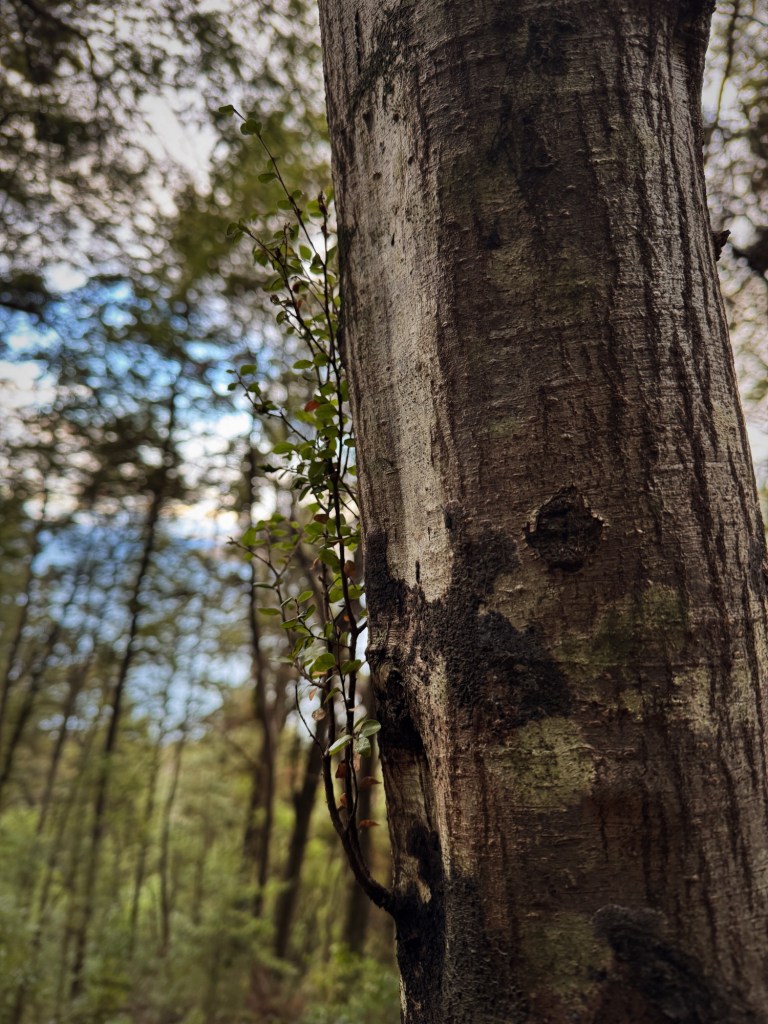
I leave you with this image. A branch I saw on my hike in New zealand. This small branch is abiding in this trunk of this tree. Sometimes I read Jesus’ word and picture a branch of equal size and stature to the vine. We think we are as capable, as big as and as wise as God. After all, it is our life right? Yet we forget the proportions are more like below. We are meek, we are weak, we are honestly quite clueless. Yet we have an invitation to abide in the great trunk of our Father. A wise old tree, offering stability in every storm, supplying us with favours that last a life time, blessings to sustain us, everlasting waters and food that we shall never thirst nor hunger. I choose that tree. I choose that God. I choose to abide in Him.

 Whispers of More